
Back
/
It was 10 years ago when we came up with our mission statement: We believe that the technology in your home should be easy to use, beautifully designed, and unbelievably reliable.
For a long time—maybe since the ’90s even—this idea of a “smart home” has been floated around, but I don’t think the home has actually been smart yet. What’s been going on is that we’ve created functional utility. We’ve made homes easier to live in. We’ve reduced the number of buttons you have to hit to get things to happen. We’ve even connected voice to commands. But the home itself hasn’t actually been smart. It hasn’t been thinking.
Today, things are different. In January, I woke up in the middle of the night, and that mission statement boiled down to five words in my mind: simple, beautiful, reliable, intelligent home. “Intelligent home” is what came to me. That’s what we’ve been looking for. That’s what we’ve been promising all this time. But we haven’t had intelligence driving anything in the home.
Since January, I’ve been feeling like something is brewing. Something is changing in the entire space. It seems that we’re at the dawn of a truly intelligent home. Could the home be thinking for you? Thinking of ways to make your life easier, more convenient, or more comfortable? Thinking of ways to simplify your day and your experience at home?
Yesterday, I saw a keynote address from Josh.AI, one of our brand partners that we work with. They have come up with something that is truly remarkable, innovative, and different. It is a game changer. It is a paradigm shift. For the first time ever, a homeowner or user is able to pick up a remote control and tell it what they want the button to do—without hiring a programmer and without writing code.
It’s analogous to what’s going on in the business world right now. Have you heard of the Saaspocalypse? For the first time, AI agents are rewriting software custom for businesses without having to hire a programmer. And at the same time that shift is happening, we are seeing a dramatic shift in the home technology space.
Can you imagine being alive when dishwashers, washing machines and dryers first came into the home? All your life, you had to manually do these things, and then suddenly there was machinery that would do it for you. I feel like we’re on that kind of a shift with home technology.
About 10 years ago, I filled out a questionnaire for Josh.AI, and I was so fascinated with the ideas of what they were talking about doing that I just answered every question and wrote a novel back to them. The next day, I got a phone call from their head of business development, and we talked on the phone for two hours about all of the dreams and plans and goals that they had as a company. Soon after, they came to our showroom and installed the demo system. It was incredible.
The idea that I could just use voice to turn on lights… now what they’ve come out with is truly intelligent. It’s not just voice-to-text-to-command. It’s not pre-programmed by an engineer. It’s a system that can actually think for you.
They showed a demo where a user could just say something simple like, “I’m having people over tonight, and I’d like to create an atmosphere that is warm and inviting and cozy for our party.” The system actually considered the request and suggested turning lights down to 30% in certain areas, closing shades and drapes, and then playing jazz music on the system. Jazz music was the recommendation! Now, that is actually thinking.
I can only dream about what’s on the horizon next.
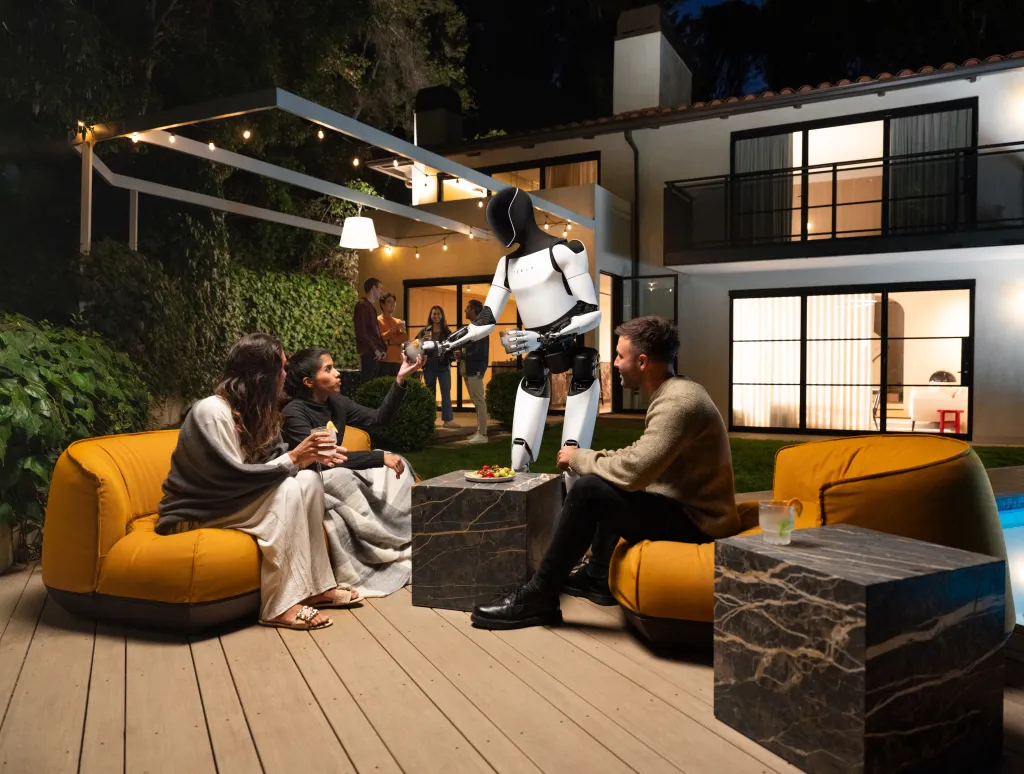
Going back to that conversation with Nader all those years ago, I said to him, “Somebody has to sell the robots. Somebody’s got to maintain the robots. Why can’t that be our industry? Why can’t we do that?”
Recently, my middle daughter sent me a link to one of the bloggers that she follows doing a scary review about a new humanoid robot that is designed to work in the home. She was totally freaked out by it. She said that right now it’s actually operated by a person who’s looking into your home through the camera eyes on the robot. This is to collect training data for their ai.
Remember how Teslas learned how to do self-driving? The AI watched video of Teslas driving—hours and hours and hours of video. Elon said he didn’t teach them how to read. They just learned how to read stop because that’s what cars do when they come to stop signs.
So the idea that this company was putting forth was that they would introduce all of these humanoid robots into the home and physically steer them with an human until they had enough data to train the AI to do housework.
My daughter was just freaked out: “Seriously, you’re gonna bring somebody into your home where they can look through the camera and see your house—whatever is going on—all the time?”
But how do we do that? How do we train something to work in the home otherwise? And that ties into the whole security and privacy thing that Josh is always harping on. That’s their selling point as a product: that they’re not like Alexa or Google or Apple or anything else like that because they are totally secure and private. They’re not stealing your data. They’re not recording your conversations or data mining.
It’s like the book Surveillance Capitalism by Shoshana Zuboff that came out a few years ago. We’re arguing over who the data belongs to when the data shouldn’t even exist. I think it was the marketing guy at Josh who told me, “If the product’s cheap, you are the product”—which is totally creepy. At least Josh.ai is built on a core value of protecting your privacy.
I took my dad for a ride in my new Tesla, and he was terrified. I’m totally comfortable with it. I can go right down the freeway and hit the button—not even touch the wheel. It doesn’t bother me. But for him, it’s just too much. It’s too weird.
Many years ago, there was a goofy TV series on the Sci-Fi channel that I really loved to watch. It was called Eureka, and it’s about a town of nerds where everything is futuristic. They have the most advanced technology on earth. One of the lead characters lived in a smart home, but this smart home was actually an intelligent home. He would walk in the door, and the home—which is called SARAH—would say, “Welcome home. How was your day? Can I get you something to drink?” And then it would pour a beer for him. In the kitchen, it would come out of a dispenser like a Bosch coffee maker. It would turn the lights on for him. It would turn music on for him. It was providing predictive care. It would tell him who was at the door when a visitor arrived. It would make a suggestion for dinner. It could look into the fridge and re-order staples.
There’s just one elephant in the room. If the robot is going to control the house, it has to have something to control. No matter what the operating system ends up being, you have to have a shade motor, smart speaker, motion sensor, smart thermostat, relays and connected APIs. You have to have a lighting dimmer, and you have to have rock solid networking and WiFi throughout the house. The intelligent home has to have intelligent parts, or there’s nothing for it to connect to.
The only thing missing in the Eureka series was a humanoid robot walking around like Rosie on The Jetsons.
I’ll admit… I like that future. It’s a little creepy, I know, but I like the idea of being able to show up at my door and the house knows it’s me and unlocks the door, recognizes me, and turns on my music and the lights that I would want turned on. It knows to close the shade on the west side at a certain time of day. It knows that I like it a certain temperature when I’m sleeping and I’d rather it be warmer when I wake up. It knows to turn the lights on for me, to open the shades for me before the alarm goes off so that I’m waking up comfortably and naturally without the shock of an alarm clock. It knows how much cream I want in my coffee.
That’s the future I’m looking for, and I think we’re right on the edge of it.
Donnie Boutwell, CEO
Ready to start your home automation journey?
From planning to execution, we can guide you every step of the way.Get In Touch